Skip to product information

1
/
of
1
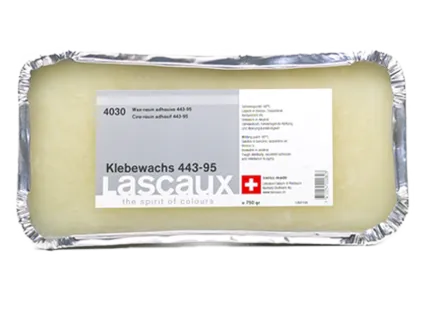
Lascaux Adhesive Wax 443-95 – Lining, mounting and facing
Lascaux Adhesive Wax 443-95 – Lining, mounting and facing
Regular price
57,24 €
Regular price
Sale price
57,24 €
Unit price
/
per
Taxes included.
Shipping calculated at checkout.
Share
Couldn't load pickup availability
Lascaux Adhesive Wax 443-95 — the wax-resin adhesive for lining, mounting and facing
It is not wax alone: it is a compound of microcrystalline wax and synthetic polyterpene resin. The resin acts as an elastomer and a tackifying agent, provides high adhesive and bond strength, and improves wettability and moisture resistance. It is worked molten, and its relatively sharp melting point allows quick bonding, mounting and backing. If what you are after is microcrystalline wax on its own, that is Lascaux Microcrystalline Wax I30, and it does a different job.
What is it used for?
- Conventional lining of paintings on canvas
- Lining with fibreglass fabric, where the lining has to be completely transparent
- Sandwich lining, with an intermediate fabric between the original and the lining
- Bonding and mounting work, temporary or permanent, such as balsa wood backing
- Facing of the paint layer, either diluted in solvent or applied as a solid
Why choose Lascaux Adhesive Wax 443-95?
- The five uses above are the ones its manufacturer declares in the technical data sheet, with their working temperatures — they are not an attribution of ours
- It disconnects easily with a hot air gun. The technical data sheet says so itself, and says it twice: a backing mounted with this adhesive can be taken off again
- Viscoplastic and ageing resistant, with an acid number under 1
- Sharp melting point, 68 °C, softening from about 60 °C: the working window is narrow and predictable, which is what a hot table calls for
- No hazard classification: its safety data sheet states «none» for classification and for labelling under the European regulation on hazardous chemicals (CLP), and its components do not meet the criteria for persistent and bioaccumulative substances of the European chemicals regulation (REACH)
How it is applied, according to the manufacturer
- Keep it liquid in a double boiler, at a constant temperature of about 60 °C
- Apply with brush, roller or spatula, as thinly and evenly as possible. A hot air gun may also be used
- Optimum results are obtained on a hot table, at about 50-60 °C
- Sealing occurs at 68 °C on the hot table, at best under vacuum
- Smaller objects may also be sealed with a pressing iron
- Solubility: soluble in aliphatic and aromatic solvents; insoluble in alcohol
Manufacturer's technical data
- Composition: microcrystalline wax and synthetic polyterpene resin
- Melting point: 68 °C, softening from about 60 °C (its safety data sheet gives it as a range of 60–68 °C)
- Gardner colour: No. 4
- Acid number: under 1
- Appearance: solid, white, practically insoluble in water
Presentation and storage
- Presentation: 750 g aluminium tin
- Storage: keep it in its original container, dry and cool, away from heat and direct sunlight
The limits, stated
- It is not a consolidant. It is a hot-melt adhesive: it bonds between two surfaces, it does not penetrate into a disaggregated layer. If what you need is to consolidate, the product for that is Lascaux Medium for Consolidation
- Facing is temporary and gets removed. It goes over the paint layer to hold it while the reverse is being worked on; it does not stay there as protection
- It is applied hot. At high temperatures it may give off decomposition products — carbon monoxide and dioxide, smoke and oxides of nitrogen — so work with ventilation and without going past the working range: reaching the 68 °C of sealing is enough
- The manufacturer asks you to test its suitability beforehand on the specific substrate and under the intended conditions of use. He says so himself in the data sheet, and with an original in front of you that is the step you do not skip
Frequently asked questions
How does it differ from Lascaux Microcrystalline Wax I30?
The I30 is microcrystalline wax alone, with no resin, and its manufacturer lists it as an encaustic medium. The 443-95 has synthetic polyterpene resin added, and it is the resin that gives it its adhesion: that is why its manufacturer declares it for linings, mountings and facing. Two different jobs, even though both are waxes.
Is it suitable for consolidating a flaking paint layer?
No. Its manufacturer does not offer it for that, and it is not what it does: it is an adhesive that melts at 68 °C and bonds between two surfaces, not a product that penetrates into a disaggregated ground. What it does declare regarding the paint layer is facing, which is temporary and gets removed. For consolidation, look at Lascaux Medium for Consolidation, and if you have a specific case write to us and we will look at it.
Can it be removed afterwards?
Yes. Its technical data sheet says twice that it disconnects easily with a hot air gun, and says it specifically of balsa wood backing. It is also soluble in aliphatic and aromatic solvents, and insoluble in alcohol.
At what temperature is it worked?
In a double boiler it stays liquid at a constant 60 °C or so; on a hot table the optimum is 50-60 °C, and sealing occurs at 68 °C, at best under vacuum. Its safety data sheet gives the melting point as a range of 60 to 68 °C.
Which fabrics is it used with for lining?
Its manufacturer declares conventional canvas lining, fibreglass fabric lining where the lining must stay transparent, and sandwich lining. In our catalogue we carry Lascaux Lino Puro L-40 and Lascaux Portrait Linen 990 as lining fabrics.
Does it carry a hazard pictogram?
No. Its safety data sheet, revised in April 2026, states «none» for classification and for labelling, and no hazardous ingredient. Even so, it is applied hot: work with ventilation.
Can it be collected in Barcelona?
Yes. Message us on WhatsApp before ordering and we will confirm availability and a collection window.
Have questions? Message us on WhatsApp, visit innovart.art or email us at info@innovart.art for advice.