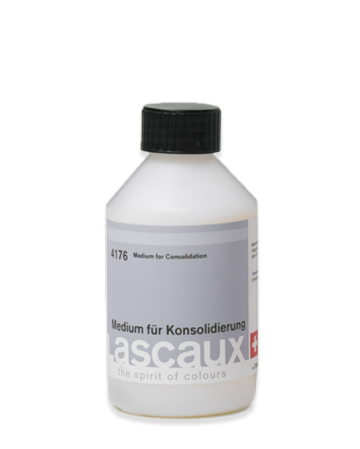
Lascaux Medium for Consolidation — Acrylic Consolidant for Restoration
Lascaux Medium for Consolidation — Acrylic Consolidant for Restoration
Share
Couldn't load pickup availability
Lascaux Medium for Consolidation: low viscosity acrylic consolidant
Lascaux Medium for Consolidation is an aqueous dispersion of finely dispersed copolymer with extremely low viscosity, developed in collaboration with the Swedish National Heritage Board for the consolidation of paint layers in medieval polychrome on wood. It penetrates deeply without creating a visible surface film, preserving the original appearance of the artwork.
Applications
- Consolidation of powdery paint layers and flaking
- Fixing polychrome on wood, gilding and estofado
- Stabilization of wall paintings and fragile preparations
- Surfaces sensitive to humidity: gilding and thin tempera layers
- Historical supports on wood or textile with loss of internal cohesion
- In fine arts: fixing fragile layers, mixed media and stabilization of delicate acrylic preparations
Features
- High penetration: its low viscosity reaches internal layers without surface excess
- Flexible and transparent film: very discreet matte/satin finish
- Partial reversibility: soluble in esters, aromatics, acetone and MEK
- Light and aging resistance: long-term stable in museum conditions
Technical characteristics
- Base: finely dispersed aqueous copolymer
- MFFT (Minimum Film Formation Temperature): approx. 4°C
- pH: 8–9
- Dilution: water
- Drying: transparent
- Finish: very discreet matte/satin
- Subsequent solubility: esters, aromatics, acetone, MEK
- Lightfastness: yes
- Aging resistance: yes
- Warnings: H319, EUH208
Recommendations for use
Apply with a brush, syringe, controlled nebulization, Japanese paper or suction table (depending on the intervention). Always perform prior compatibility and penetration tests before general application.
When to choose Lascaux Medium for Consolidation?
Choose it when you need to consolidate powdery or disaggregated paint layers with a water-based medium with great penetration and a stable film. Compared to a solvent-based consolidant (such as a dissolved acrylic resin like Paraloid B-72), its aqueous system avoids adding organic solvents to the artwork; the choice depends on the layer's sensitivity to water.
Frequently asked questions
- What is it used for? To consolidate loose, powdery or internally decohesive paint layers.
- Is it water-based? Yes, it is an aqueous dispersion that can be diluted with water before drying.
- Why does it penetrate so well? Due to its extremely low viscosity, optimized for consolidation.
Combine with
Do you have any questions? Write to us on WhatsApp, visit innovart.art or write to us at info@innovart.art and we will advise you.