Skip to product information

1
/
of
1
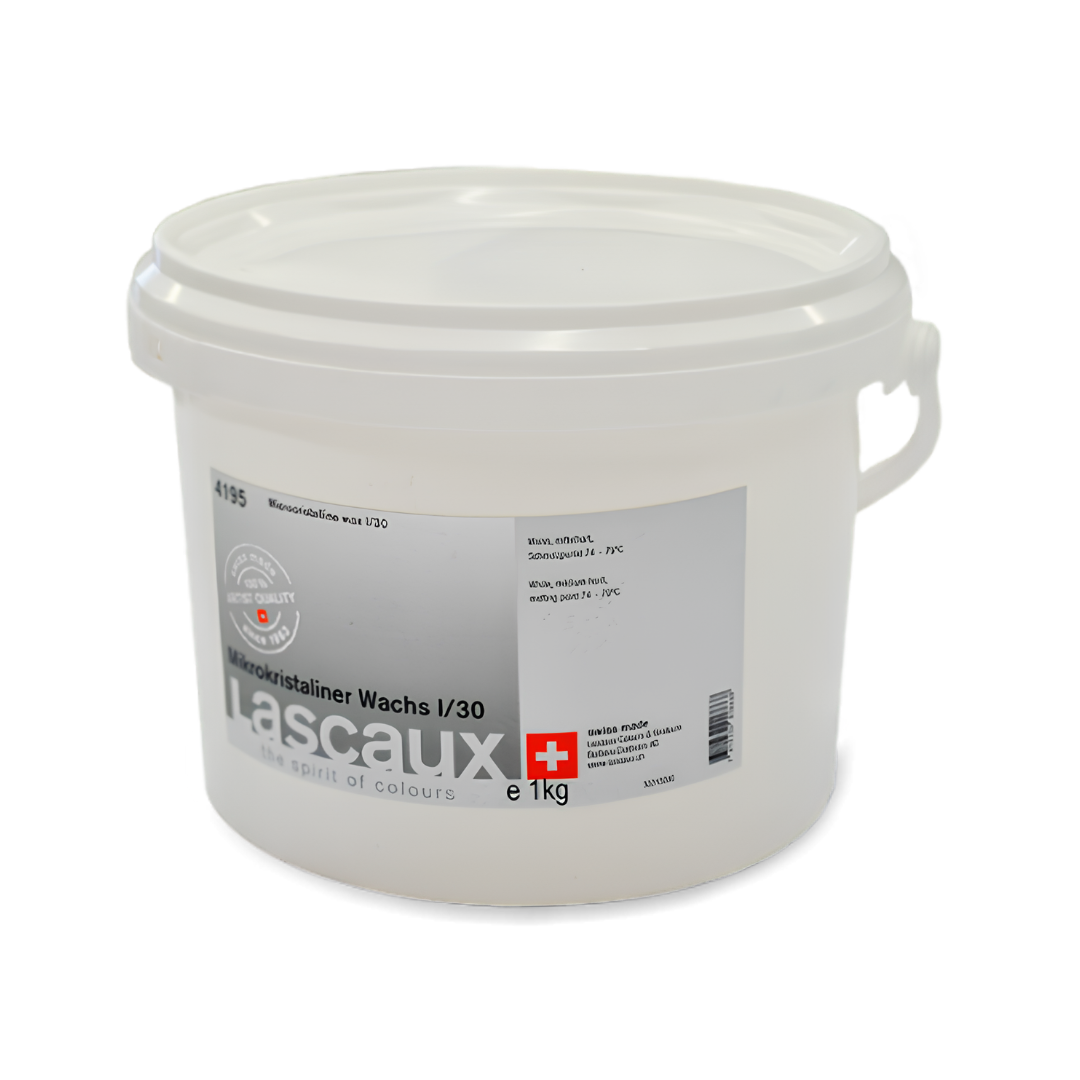
Lascaux Microcrystalline Wax I30 – Encaustic, Conservation and Restoration
Lascaux Microcrystalline Wax I30 – Encaustic, Conservation and Restoration
Regular price
104,13 €
Regular price
Sale price
104,13 €
Unit price
104,13 €
/
per
kg
Taxes included.
Shipping calculated at checkout.
Share
Couldn't load pickup availability
Lascaux Microcrystalline Wax I30 — the wax Lascaux lists as an encaustic medium
A chemically inert wax of saturated hydrocarbons obtained from petroleum, whose microcrystalline structure increases its flexibility. Lascaux lists it in its own catalogue as Mikrokristalliner Wachs I30 / Enkaustik-Malmittel: microcrystalline wax I30, encaustic medium. It melts between 74 and 79 °C, a low melting point for a microcrystalline wax, so it softens and works warm sooner than high-melting grades. Do not confuse it with Lascaux Adhesive Wax 443-95, which contains a polyterpene resin and is a lining adhesive.
What is it used for?
- Preparing the encaustic medium: melting the wax, loading it with pigment and painting hot
- Replacing or remaking the wax finish of a work painted in encaustic
- Final wax layer over an already applied varnish, as a sacrificial and matting coat — never as the only layer
- Solid microcrystalline wax for the studio that prepares its own mixtures and wants to start from a single-component wax
Why choose Lascaux Microcrystalline Wax I30?
- The encaustic use is declared by the manufacturer in the product name itself — Enkaustik-Malmittel, encaustic medium — it is not an attribution of ours
- Chemically inert and with no hazard classification: its safety data sheet states «none» for classification, for labelling and for other hazards under the European regulation on hazardous chemicals (CLP)
- Melting point of 74 to 79 °C: it melts sooner than hard microcrystalline waxes, which allows hot working at a lower temperature
- Single component, with no solvent in the container: it arrives solid and the studio decides how to melt it and what to load it with
Manufacturer's technical data
- Composition: wax of saturated hydrocarbons of petroleum origin
- Hardness: medium
- Colour: white
- Melting point: 74–79 °C (its safety data sheet states 73–80 °C)
- Penetration (25 °C): 20–35 1/10 mm
- Compliance: the manufacturer states that it meets FDA requirements, the United States Food and Drug Administration
Presentation and storage
- Presentation: 1 kg tub
- Solid at room temperature, white, odourless and insoluble in water
- Storage: the manufacturer requires no particular measures. Keep it in its original container, dry and cool, away from heat and direct sunlight
The limits, stated
- On metal, a microcrystalline wax does not go on its own. The criterion of the Spanish Institute of Cultural Heritage (Instituto del Patrimonio Cultural de España) is that these waxes are not usually applied directly onto the metal, and impedance tests on bronze measure that wax by itself offers very little barrier. It belongs to the last step, over an already applied varnish, as a sacrificial and matting layer: that is where the literature places it
- Do not build up wax layers without removing the previous one. Once hardened it is difficult to remove, and build-up makes it practically irreversible. Removing the old layer before reapplying, periodic maintenance is normal practice
- It is applied molten. At high temperatures it may give off decomposition products — carbon monoxide and dioxide, smoke and oxides of nitrogen — so work with ventilation and without overheating it: reaching the melting point is enough
- It is not a consolidant nor a lining adhesive. If what you are looking for is the Lascaux adhesive wax for lining, that is the 443-95; if you are looking for a reversible acrylic resin for consolidation, Paraloid B-72
Frequently asked questions
Is it suitable for protecting a bronze?
As a wax, yes, but at the last step: over an already applied varnish, as a sacrificial and matting layer. What the literature does not support is wax as the only protection of a bronze — the criterion of the Spanish Institute of Cultural Heritage advises against it on reversibility grounds, and electrochemical impedance tests on bronze measure that a microcrystalline wax on its own offers very little barrier. If you are dealing with a bronze with active corrosion, write to us before buying and we will look at it with your case in front of us.
How does it differ from Lascaux Adhesive Wax 443-95?
The 443-95 is microcrystalline wax plus a synthetic polyterpene resin, formulated as an adhesive: its manufacturer declares it for canvas linings, fibreglass fabric and balsa wood backings. The I30 is wax alone, with no added resin, and its manufacturer lists it as an encaustic medium. They are two different jobs.
At what temperature should it be melted?
Its melting point is 74 to 79 °C according to the manufacturer's listing, and 73 to 80 °C according to its safety data sheet. Reaching that range is enough: going higher than necessary improves nothing and is precisely what can generate decomposition products.
Is it a natural wax?
No. It is a microcrystalline wax, that is, a mixture of saturated hydrocarbons obtained from petroleum — that is how the manufacturer itself describes it. The microcrystalline structure is what gives it flexibility compared with a coarser-crystal wax.
Which solvent dissolves it?
Lascaux does not publish a recommended solvent for this reference, so we are not going to attribute one to it. If you need to work it in solution rather than molten, write to us and we will look at it according to what you have in hand.
Does it carry a hazard pictogram?
No. Its safety data sheet states «none» for classification, for labelling and for other hazards, and no hazardous ingredient. Even so, it is applied hot: work with ventilation.
Can it be collected in Barcelona?
Yes. Message us on WhatsApp before ordering and we will confirm availability and a collection window.
Have questions? Message us on WhatsApp, visit innovart.art or email us at info@innovart.art for advice.