Skip to product information
1 of 1

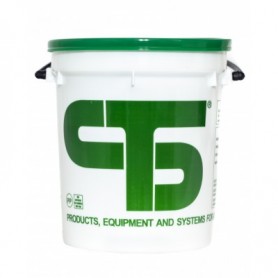
Paraloid B-72 (1 kg)

Paraloid B-72 (1 kg)

Regular price €49,86 EUR
Regular price Sale price €49,86 EUR
Sale Sold out
Taxes included. Shipping calculated at checkout.

Paraloid® B-72 (1 kg) — solid acrylic resin: you set the concentration

Paraloid® B-72 is a copolymer of ethyl methacrylate and methyl acrylate in transparent granules: a solid, thermoplastic acrylic resin with no solvent, for professional use in Conservation-Restoration (C&R). You buy it dry and decide the solvent and concentration yourself: the same resin can prime a fracture edge, consolidate by impregnation, or bond in a thick mixture. Its glass transition temperature (Tg, the temperature at which the polymer goes from rigid to soft) is 40 °C, and that is where both its heat reactivation and its limits come from.

What is it used for?

  • Consolidation by impregnation of wood and stone: the supplier's general range is 2 % to 10 % in solvent, and for wood and marble the product's technical data sheet narrows this to 5-10 %. Best results come from slow immersion of the piece: capillary absorption consolidates in depth and evenly.
  • Mural painting, silicate paint and friable renders: at 5 % maximum in toluene/isopropanol, in several coats up to saturation.
  • Paint layer and ground layer on wood or canvas: at 5-10 % in toluene or toluene/isopropanol.
  • Priming of fracture edges and bonding in low-fired ceramics, terracotta and pottery: the edges at 5-10 % w/v (weight/volume: grams of resin per 100 ml of solvent) in acetone with a brush, fully dried, then the thick adhesive mixture on top.
  • Fixative for charcoal, chalk, graphite pencil and pastel, at 2-4 % in toluene or isopropanol.
  • Sealing of accession numbers (inventory marks on museum objects): base coat at 20 % w/v in acetone, dried for about 15 minutes, ink, and a sealing coat on top.

Why choose Paraloid B-72?

  • You set the concentration, and with it the penetration. At 2-10 % it impregnates and consolidates in depth; in a thick mixture it stays at the joint and bonds. It is the same material adapted to whatever substrate you have in front of you, not two different products.
  • It reactivates, including with heat. It is thermoplastic: a few minutes with a heat gun and an already-set joint moves and realigns; hold it for about 30 seconds until it cools. It also reactivates with acetone. When heating it, work with ventilation: the hot resin gives off monomer vapours that irritate the nose, throat and airways.
  • Stability documented in the literature. Feller classed it “Class A”, with an estimated stability of over 100 years. Dow describes it as a stable, non-yellowing resin.
  • Softer film than the B-66: Knoop hardness of the dry film (KHN) of 10-11, versus 12-13.
  • As an interface barrier in stone sculpture, between the original and a structural adhesive (epoxy, polyester) it increases the reversibility of the joint: it is applied to both faces and the solvent is left to evaporate before the secondary adhesive.

Presentation and storage

  • Presentation: 1 kg pack, transparent, colourless granules. Solid resin, 100 % dry residue: contains no solvent.
  • Storage: between 5 and 35 °C, in a dry, well-ventilated place. Away from heat sources, oxidising agents and strongly acidic or alkaline materials. Opened containers kept well closed and upright.
  • Shelf life: once dissolved, the resin keeps indefinitely as long as the container stays well closed.
  • Approximate coverage: 10-30 m² per 100 g of dry product. The product's own data sheet notes that this is hard to pin down, as it depends on the porosity of the substrate and the dilution.

Limits of use

  • Not for outdoor use, nor for storage at extreme temperatures: the literature expressly advises against 50 °C. With a Tg of 40 °C, it softens in the sun.
  • Not for joints under continuous structural load or high shear stress. The test on marble specimens concludes that the B-72/acetone mixture is not suitable for marble-marble joints where high shear stress may occur, and warns of cold creep under sustained load: with a Tg of 40 °C, deformation can occur even at 18-24 °C if the stress is sustained over decades. The test is on marble only and does not extrapolate to other substrates.
  • The water repellency it provides is only temporary. If the goal of the treatment is lasting water protection, B-72 alone does not give it.
  • It does not dissolve in water or in White Spirit and aliphatic hydrocarbons: if you plan to dilute it there, you lose the material.
  • Ethanol is a co-solvent, never the main solvent, and never above 15 % by volume: it is very hygroscopic and carries water into the mixture.
  • Intended use: professional use only.

Safety. The resin in granule form is not classified as hazardous under the CLP regulation (classification, labelling and packaging of substances and mixtures, Regulation (EC) No 1272/2008): its safety data sheet carries no pictogram or hazard statements. What does carry them is the solvent you dissolve it in —acetone, toluene, xylene or butyl acetate—: work with ventilation and check its safety data sheet.

Paraloid® is a trademark of Dow, originating at Rohm and Haas. Distributed by C.T.S. España.

Frequently asked questions

What concentration do I prepare it at?
The supplier's standard preparation is 2 % to 10 % in solvent. By case: mural painting, 5 % maximum; paint layer on wood or canvas, 5-10 %; consolidation of wood and marble, 5-10 %; priming of fracture edges, 5-10 % w/v in acetone; sealing of accession numbers, 20 % w/v in acetone; varnish, 10 % in toluene or xylene. Watch for a common mix-up: high concentrations, from 20 % upward, are for adhesive, not varnish.
Which solvent do I use, and what won't it dissolve in?
It dissolves in ketones (acetone, methyl ethyl ketone), esters and ethers (ethyl acetate, butyl acetate, propylene glycol monomethyl ether) and aromatic hydrocarbons (toluene, xylene). For low toxicity, the supplier recommends acetone and butyl acetate, and propylene glycol monomethyl ether if you need low aromatic content. In acetone the solution comes out much more fluid than in toluene, and in toluene more than in xylene; a highly volatile solvent penetrates less, so for longer working times xylene or butyl acetate work better.

It does not dissolve in water or in White Spirit and aliphatic hydrocarbons: if you plan to dilute it there, you lose the material. Ethanol is a co-solvent, never the main solvent: between 5 % and 15 % by volume it slows evaporation when working with heat, but above 15 % it is not recommended — it is very hygroscopic and carries water into the mixture.
How do I dissolve it without lumps or strings?
Solvent first. The resin is tied into a gauze bundle suspended just touching the surface of the solvent, and not stirred: the dissolved resin sinks by gravity and leaves clean solvent on top. 6 to 8 hours, overnight is better. No blenders or electric mixers: you are stirring a flammable, volatile solvent, and an electric motor is an ignition source.

For adhesive, the proportions go by grams and millilitres: fine mixture (glass), 50 g of B-72 in 105 ml of acetone; thick mixture (low-fired ceramics, porous stone, wood, bone, ivory), 50 g in 90 ml. The literature adds a pinch of hydrophobic fumed silica as a rheology agent: it gives better flow control, fewer bubbles and less stringing. It is a very light powder — handle it with gloves and a dust mask, and never in a strong draught.
Is it reversible? What reactivates it?
It is worth stating precisely: it is not “total reversibility”, it is reactivation and removal with solvent. It reactivates with acetone —too much separates the joint— and with heat-gun warmth, being thermoplastic: a few minutes of heat and the joint moves and realigns; hold it for about 30 seconds until it cools. Do this with ventilation. Damage-free removal is documented for ceramics and glass; outside those two materials, the literature does not claim it.
Does it work as a structural adhesive?
With reservations, and both sides of the test matter. On marble specimens, marble-marble joints proved more tensile-resistant than the marble itself. But the same study concludes that the B-72/acetone mixture is not suitable for marble-marble joints where high shear stress may occur, and warns of cold creep under sustained load: with a Tg of 40 °C, deformation can occur even at 18-24 °C if the stress is sustained over decades. The test is on marble only and does not extrapolate to other substrates. If the joint must bear continuous structural load, the choice is an epoxy such as Araldite 2020.
Can I use it outdoors, or as protection against water?
Outdoors, no: the literature expressly advises against it, as it does storage at extreme temperatures — it expressly advises against 50 °C. With a Tg of 40 °C, it softens in the sun.

And regarding water, the fact worth knowing before applying it: the water repellency it provides is only temporary. It reduces water absorption at the surface and in depth without altering colour or opacity, and leaves the object more compact and less fragile, but if the goal of the treatment is lasting water protection, B-72 alone does not give it.
Why does a sheen remain on the surface?
Because resin has stayed on the surface and formed a film. This is avoided by passing pure solvent over it after application and before drying: it carries away the excess and reduces the risk of film and a glossy effect. The supplier expressly warns of this in its technical data sheet.
When do I choose another product instead of B-72?
B-72 is the choice when you want a solid acrylic resin that you dose yourself, reactivable with acetone or heat. Choose another when the case calls for something else:

· Aquazol® 200 and Klucel® G — when the case does not admit an organic solvent and work must be done in an aqueous or alcoholic medium. Aquazol is a poly(2-ethyl-2-oxazoline); Klucel G is a hydroxypropyl cellulose, for anyone looking for a cellulose ether.
· Lascaux Medium for Consolidation — when the substrate tolerates water and you want a ready-to-dilute aqueous dispersion.
· Araldite 2020 — when the joint must bear continuous structural load.
· BEVA® 371 Akron — for relining and consolidation of paintings on canvas, with heat activation.
· Cyclododecane — when the reinforcement must disappear on its own by sublimation, leaving nothing behind.

Have questions? Write to us on WhatsApp, visit innovart.art or email us at info@innovart.art and we'll advise you.

View full details