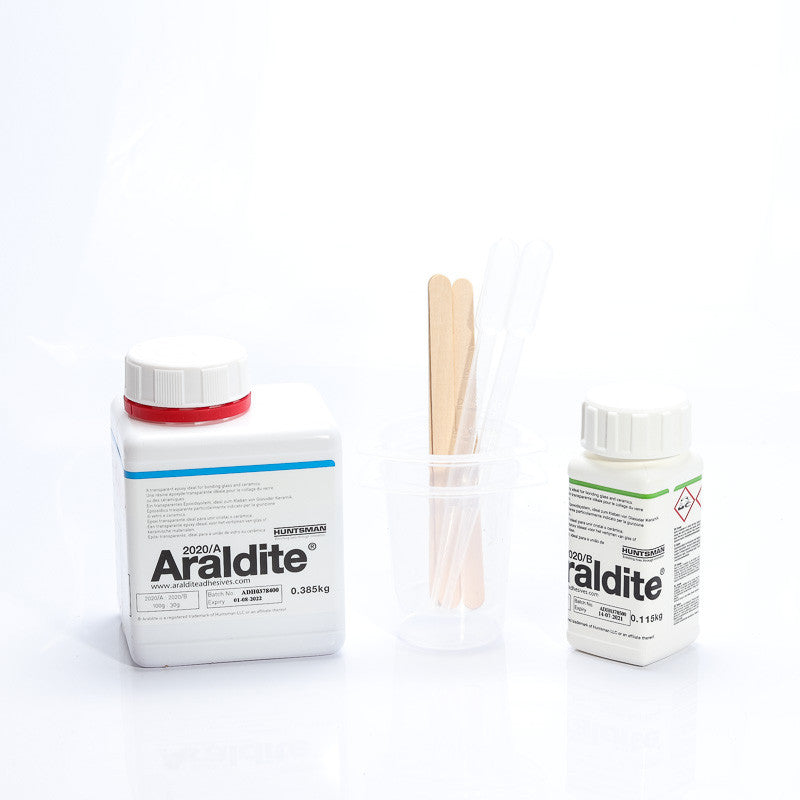
Araldite 2020 (500 g kit)
Araldite 2020 (500 g kit)
Share
Couldn't load pickup availability
Araldite® 2020 — Transparent Epoxy Adhesive for Glass and Ceramics
Araldite 2020 is a two-component epoxy adhesive with low viscosity, cured at room temperature (XW 396 resin + XW 397 hardener). It is the usual reference in conservation-restoration for bonding glass and ceramics, where the bond line needs to be as invisible as possible.
What is it used for?
- Bonding glass: fragments, clean breaks, joints that need to be discreet
- Bonding ceramics and porcelain in object restoration
- Joints in stone and stone materials
- Assemblies requiring permanent strength
Permanent bond
Araldite 2020 cures at room temperature and forms a permanent structural bond, with the glue line practically invisible on glass. If your treatment calls for a bond that is reversible in solvent, write to us on WhatsApp and we will tell you which adhesive in our catalogue fits your approach.
Presentation and Storage
- 500g kit: 385g of component A (2020/A, resin) + 115g of component B (2020/B, hardener)
- Mixing ratio 100:30 by weight
- Two-component product: do not mix more quantity than will be applied
- Work with ventilation and gloves
- Keep closed, in a dry and cool place
Safety
Manufacturer's classification (Huntsman safety data sheets: resin version 1.5 and hardener version 1.3, of October 6, 2023; and Spanish version of the resin 1.3 and the hardener 1.1, of May 12, 2020). Signal word: Danger.
RESIN (385 g) — Acute toxicity by inhalation, category 4 · Skin irritation, category 2 · Serious eye damage, category 1 · Skin sensitisation, category 1 · Hazardous to the aquatic environment, chronic hazard, category 2.
Pictograms: GHS05 (corrosion) · GHS07 (exclamation mark) · GHS09 (environment).
- H315 — Causes skin irritation.
- H317 — May cause an allergic skin reaction.
- H318 — Causes serious eye damage.
- H332 — Harmful if inhaled.
- H411 — Toxic to aquatic life with long lasting effects.
Precautionary statements: P261 Avoid breathing dust/fume/gas/mist/vapours/spray · P264 Wash hands thoroughly after handling · P273 Avoid release to the environment · P280 Wear protective gloves/protective clothing/eye protection/face protection · P305+P351+P338+P310 IF IN EYES: Rinse cautiously with water for several minutes. Remove contact lenses, if present and easy to do. Continue rinsing. Immediately call a POISON CENTER/doctor · P391 Collect spillage.
Contains: bis-[4-(2,3-epoxypropoxy)phenyl]propane and 1,4-bis(2,3-epoxypropoxy)butane.
HARDENER (115 g) — Acute toxicity by ingestion, category 4 · Skin corrosion, sub-category 1A · Serious eye damage, category 1 · Skin sensitisation, category 1 · Hazardous to the aquatic environment, chronic hazard, category 3.
Pictograms: GHS05 (corrosion) · GHS07 (exclamation mark).
- H302 — Harmful if swallowed.
- H314 — Causes severe skin burns and eye damage.
- H317 — May cause an allergic skin reaction.
- H412 — Harmful to aquatic life with long lasting effects.
Precautionary statements: P261 Avoid breathing dust/fume/gas/mist/vapours/spray · P273 Avoid release to the environment · P280 Wear protective gloves/protective clothing/eye protection/face protection · P301+P330+P331 IF SWALLOWED: Rinse mouth. Do NOT induce vomiting · P303+P361+P353 IF ON SKIN (or hair): Take off immediately all contaminated clothing. Rinse skin with water [or shower] · P304+P340+P310 IF INHALED: Remove person to fresh air and keep comfortable for breathing. Immediately call a POISON CENTER/doctor · P305+P351+P338+P310 IF IN EYES: Rinse cautiously with water for several minutes. Remove contact lenses, if present and easy to do. Continue rinsing. Immediately call a POISON CENTER/doctor.
Contains: 3-aminomethyl-3,5,5-trimethylcyclohexylamine and 2,2,4(or 2,4,4)-trimethylhexane-1,6-diamine.
Full safety data sheet available upon request at info@innovart.art.
Araldite® is a trademark of Huntsman.
Frequently asked questions
Can it be removed later?
Why 385g and 115g, and not half of each?
Is it suitable for metal or plastic?
Do you have questions? Write to us via WhatsApp, visit innovart.art or email us at info@innovart.art and we will advise you.