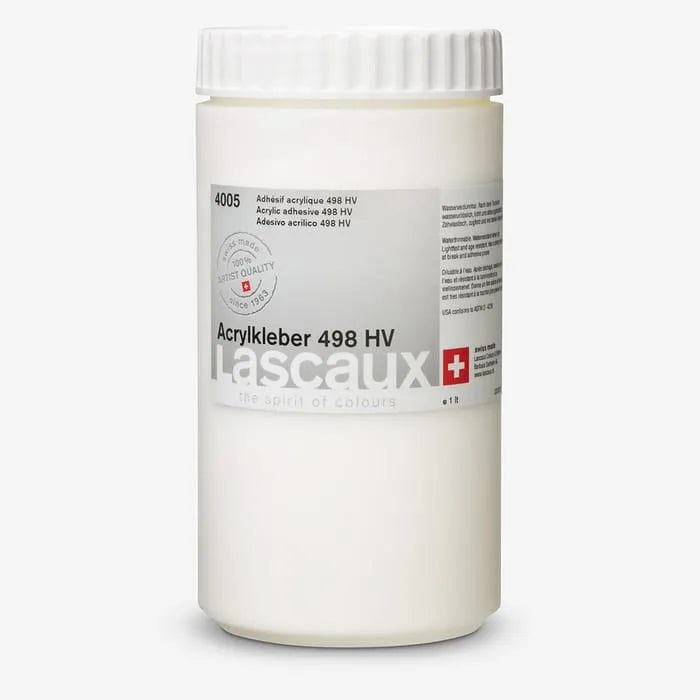
Lascaux 498 HV Acrylic Adhesive – The Standard for Lining and Marouflage
Lascaux 498 HV Acrylic Adhesive – The Standard for Lining and Marouflage
Share
Couldn't load pickup availability
Lascaux Acrylic Adhesive 498 HV — the type the manufacturer declares standard for lining and marouflage
Lascaux 498 HV is an aqueous acrylic copolymer dispersion, thickened with acrylic copolymer, pasty and white in the container, that dries clear. It is not a polyvinyl acetate: it is an acrylic dispersion formulated for Conservation-Restoration, and its dry film is hard elastic and tack-free, not permanently tacky. It is applied wet or reactivated once dry. The manufacturer lists it as the standard type for linings and marouflages.
What is it used for?
- Lining of paintings on canvas. This is the use the manufacturer names as the standard type for this product.
- Marouflage: mounting fabric or paper onto a rigid support.
- Laminations and collages, applied wet or by reactivating the dry film.
- Reactivatable reinforcement strips and linings on paper. A thin layer is spread on siliconised polyester, left to dry, and then reactivated with a heated spatula or a local application of ethanol; since it introduces no water, it leaves no tidelines and does not distort the support. The prepared strips are stored between polyester sheets (Sheesley, 2011, the paper conservation group's annual of the American Institute for Conservation, vol. 30).
- Supports: the manufacturer indicates it for absorbent and non-absorbent supports, and cites paper and cardboard, textiles, wood and fibreboards, polyester sheets, plaster and concrete, glass and acrylic glass, and aluminium.
If what you have is lifting paint layers, this is not the product. The 498 HV is a structural adhesive: it bonds supports. To consolidate paint layers, use the Lascaux Medium for Consolidation; and when the treatment calls for a non-aqueous system, the manufacturer attributes consolidation of grounds and paint layers, and facing, to its heat-seal adhesive Lascaux 375 P (check availability), which activates at 62-65 °C and is insoluble in alcohol.
Why choose Lascaux 498 HV?
- Standard type for linings and marouflages according to the manufacturer's own technical data sheet (edition 58370.02·11.24).
- Hard elastic, tack-free and clear dry film, with an elongation at break of approx. 400%, which the manufacturer describes as a strong elongation. It leaves no permanently tacky layer, unlike Lascaux 303 HV.
- Dissolves in ethanol, as well as in acetone, toluene and xylene. This allows removal with a non-aromatic solvent — 303 HV only swells in ethanol.
- No aromatic solvent in the container. Lascaux 498 20-X (check availability) is this same adhesive with 20% Thinner X (xylene) and is classified as hazardous; 498 HV does not contain it.
- The manufacturer declares bonds that are light-resistant, non-ageing and non-crosslinking.
Support fabric. If the job calls for a polyester non-woven fabric, the one we carry is Hollytex Lascaux (check availability).
Packaging and storage
- Packaging: 85 ml bottle (ref. 4005.18) · 1 l tin (ref. 4005.62) · 5 l pail (ref. 4005.78)
- Container closed when not in use, at a constant temperature between 5 °C and 25 °C. Store in containers of the same material as the original, dry and cool, away from heat and direct sunlight.
- Below 5 °C the film does not form correctly: that is its minimum film-forming temperature (MFT). Worth bearing in mind in a cold workshop or an unheated indoor treatment.
- Shelf life: the manufacturer does not publish any shelf-life or expiry data.
Manufactured by Lascaux Colours & Restauro (Barbara Diethelm AG, Brüttisellen, Switzerland). Useful note when reading the literature: much of the literature before ~2015 refers to "Lascaux 360/498", and the 360 HV does not appear in the manufacturer's current catalogue (edition 11.24). The manufacturer itself notes that its information "does not absolve the user from the responsibility of first testing the suitability of its products for the substrate and specific use conditions".
Limits of use — where this is not the right product
- Photographic works: no. The Canadian Conservation Institute found that 498 HV fails the Photographic Activity Test (PAT) — the standardised test that determines whether a material may be placed in contact with photographic material — in the part testing oxidation and reduction of colloidal silver. Batch-to-batch variation was also documented, with a recommendation to test each new batch. Cannon, 2013, Topics in Photographic Preservation 15 (American Institute for Conservation), citing Down et al., 2011.
- Lifted paint layers and consolidation of strata: no. The 498 HV is a structural adhesive, it bonds supports. That is what the Lascaux Medium for Consolidation is for, or the Lascaux 375 P (check availability) if the treatment calls for a non-aqueous system.
- Water alone does not reverse it. Dry, the film is insoluble in water and in white spirit. In testing it swelled 10% unaged and 0.6% aged, and the author concludes that swelling with water alone would not reverse a polymer film. Duffy, 1989, Journal of the American Institute for Conservation (JAIC) 28(2).
- Reversibility cannot be assumed over the years. The manufacturer declares it does not crosslink, but in accelerated ageing the peel strength rose by around 1,000 g on average, which the author interprets as increased difficulty of reversibility, calling for further testing. Duffy, 1989, JAIC 28(2).
- Below 5 °C the film does not form. That is its minimum film-forming temperature (MFT), according to the manufacturer.
- Supports the manufacturer does not name. Its list is a list of examples, not a closed list: it neither endorses nor excludes what it does not cite. For any other support, test suitability beforehand — which is exactly what the manufacturer itself requires in its technical data sheet.
Safety
According to the manufacturer's safety data sheet (SDS), this product is not classified under Regulation (EC) 1272/2008 (CLP): it carries no pictogram, no signal word, and no hazard (H) or precautionary (P) statements.
Mandatory labelling statement (EUH208): "Contains 2-methyl-2H-isothiazol-3-one and 1,2-benzisothiazol-3(2H)-one. May produce an allergic reaction."
It is not dangerous goods for transport purposes. Protective goggles are recommended against splashes. After skin contact, wash with soap and water; do not use solvents or thinners.
The safety data sheet gives no toxicological or ecotoxicological data, and the manufacturer declares no chemical incompatibilities. At elevated temperature it can generate carbon monoxide and carbon dioxide, smoke and nitrogen oxides.
Do not confuse with Lascaux 498 20-X, which is a different product: it contains xylene and is classified, with the flame and exclamation-mark pictograms and the signal word "Warning". Hazard statements (H): H226, flammable liquid and vapour; H315, causes skin irritation. Precautionary statements (P): P210 (keep away from heat, hot surfaces, sparks, open flames and other ignition sources; no smoking), P233 (keep container tightly closed), P280 (wear protective gloves/protective clothing), P332+P313 (if skin irritation occurs, get medical advice/attention), P403+P235 (store in a well-ventilated place, keep cool) and P405 (store locked up). It also carries the same EUH208 statement for the isothiazolinone preservatives. Safety data for one does not apply to the other.
Frequently asked questions
How does it differ from Lascaux 303 HV?
Can it be removed once dry, and with what?
Does reversibility hold over the years?
At what temperature does the dry film reactivate?
What dilution and reactivation time does the manufacturer indicate?
Is it suitable for photographic material?
Which supports is it validated on?
Can I work with it in a cold workshop?
Do you have any questions? Write to us on WhatsApp, visit innovart.art, or email us at info@innovart.art and we will advise you.