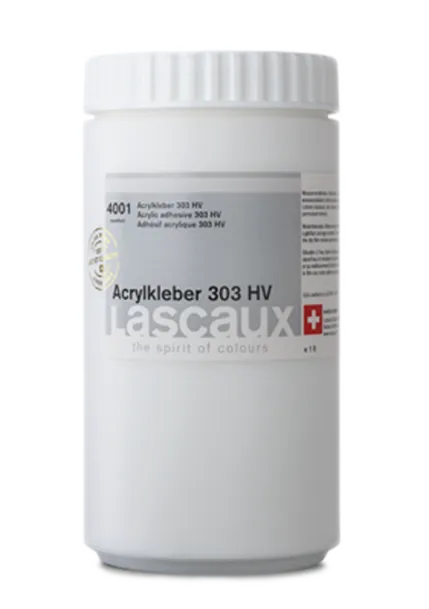
Lascaux 303 HV Acrylic Adhesive – Heat-Seal Lining and Relining
Share
Couldn't load pickup availability
Lascaux Acrylic Adhesive 303 HV — permanently tacky film, sealable from approx. 50 °C
Lascaux Acrylic Adhesive 303 HV (factory reference 4001) is an aqueous dispersion of thermoplastic acrylic copolymer, thickened with acrylic copolymer and biocide-stabilized, with a pH of approx. 9 according to the manufacturer's current safety data sheet (its technical data sheet gives the range 8-9 for the three acrylic adhesives in the range). The manufacturer identifies it as an adhesive for the conservation and restoration of art and cultural property — C&R, Conservation-Restoration. Of Lascaux's three acrylic adhesives, it is the only one whose dry film remains permanently tacky and clear, with an elongation at break greater than 1000 % and the lowest minimum sealing temperature of all the adhesives Lascaux publishes in its technical data sheet for adhesives and adhesive wax, approx. 50 °C. That is the difference from the 498 HV, which dries tack-free, elongates approx. 400 % and seals between 68 and 76 °C.
What is it used for?
- Lining (relining) by heat-sealing. It is applied wet or by reactivating the already-dry film, and the manufacturer expressly ties its use as a contact adhesive to heat-sealing. It already seals from approx. 50 °C, the lowest margin of all the adhesives Lascaux publishes in its technical data sheet for adhesives and adhesive wax, when the limit is set by the heat the artwork can withstand. The manufacturer does not publish the working order — which face the adhesive is spread on. For strip-lining and mounting of textiles, the type the manufacturer declares specially suited is the Lascaux 498 20-X.
- Laminations, collages and marouflages, applied wet or by reactivating the already-dry film, on absorbent and non-absorbent supports.
- Fixing pieces in exhibition mounting. Canterbury Museum (New Zealand) publishes a dot method with 303 HV: drops placed on baking paper, flattened with a second sheet, dried overnight and transferred to the piece, removable. Its authors warn it does not suit every object: weight, fragility, proportion and height of the piece are decisive.
Why choose Lascaux 303 HV?
- Elongation at break greater than 1000 %. It is the highest value among Lascaux's three acrylic adhesives: the 498 HV and the 498 20-X stay at approx. 400 %, according to the manufacturer's film-properties table.
- Seals from approx. 50 °C. It is the lowest minimum sealing temperature of all the adhesives Lascaux publishes in its technical data sheet for adhesives and adhesive wax: the 498 HV requires 68-76 °C and the 443-95 adhesive wax, 68 °C.
- Tg approx. −35 °C and MFT approx. 0 °C. Tg is the glass transition temperature; MFT, the minimum film-forming temperature. It forms a film at room temperature without a coalescent, and the polymer stays soft well below workshop temperature: hence the film stays tacky and accommodates the movements of the support without becoming brittle.
- Swiss manufacture specialized in C&R. Lascaux Colours & Restauro (Barbara Diethelm AG, Brüttisellen) intends this family for light-resistant, non-ageing, non-crosslinking bonds.
- And when it is not the right one. If the treatment requires being able to undo the bond with ethanol, or that the film not remain tacky, the product is the Lascaux 498 HV: the type Lascaux declares standard for lining and marouflage, which dries with a hard elastic, tack-free film, and is also removed with ethanol.
Presentation and storage
- Presentation: 1-litre can, art. 4001.62. It is the only format the manufacturer publishes for the 303 HV.
- Closed container, at a constant temperature between 5 °C and 25 °C, protected from heat and direct sunlight. In a dry, cool place, and always in a container equivalent to the original.
- Keep away from oxidizers and from strongly acidic or strongly alkaline materials.
- Shelf life: the manufacturer publishes none. It also publishes no drying time or dilution percentage: the restorer sets the working concentration.
Limits — where it is not used and what to know beforehand
- Removing it requires acetone, toluene or xylene. There is no gentle route. Ethanol and white spirit (mineral spirits) do not remove it: they only swell the film. Those three solvents do require ventilation and respiratory protection; the adhesive does not.
- The film never stops being tacky. Decades later it remains adhesive and traps dust and particles along the edges of the bond.
- Without heat, you are outside the declared use. The manufacturer ties its use as a contact adhesive to heat-sealing: without a hot table, controlled iron or hot-air gun, there is no declared use that covers it.
- It is not the manufacturer's standard type for lining or marouflage. Lascaux declares that role for the 498 HV.
- It is not declared for consolidating the paint layer or for setting down colour, nor for panel paintings, altarpieces or polychromy on wood.
- It is diluted with water only before drying. Once dry, the film is insoluble in water: there is no later aqueous correction.
- Supports named by the manufacturer: paper and cardboard, textiles, wood and fibre boards, polyester sheets, plaster and concrete, glass and acrylic glass, aluminium. What is not on that list is not endorsed.
Manufactured by Lascaux Colours & Restauro, Barbara Diethelm AG (Brüttisellen, Switzerland). Factory reference 4001 · art. 4001.62.
Safety
Contains 1,2-benzisothiazol-3(2H)-one and 2-methyl-2H-isothiazol-3-one. May produce an allergic reaction. (EUH208, European Union supplemental hazard statement)
Safety data sheet available on request. (EUH210)
According to the manufacturer's safety data sheet, the product is not classified as hazardous: it carries no pictogram or H-statements (hazard statements). Wear protective goggles if there is a risk of splashing. After skin contact, wash with soap and water; do not use organic solvents to clean it off.
Frequently asked questions
What removes 303 HV once dry?
Is it reversible with ethanol, like the 498 HV?
At what temperature does it seal?
Does the dry film stay tacky?
Can I bond cold, by pressure alone?
Can it be diluted? With what, and in what proportion?
Is it suitable for consolidating the paint layer or setting down colour?
Do I need extraction or a mask?
Do you have questions? Write to us on WhatsApp, visit innovart.art, or email us at info@innovart.art, and we will advise you.