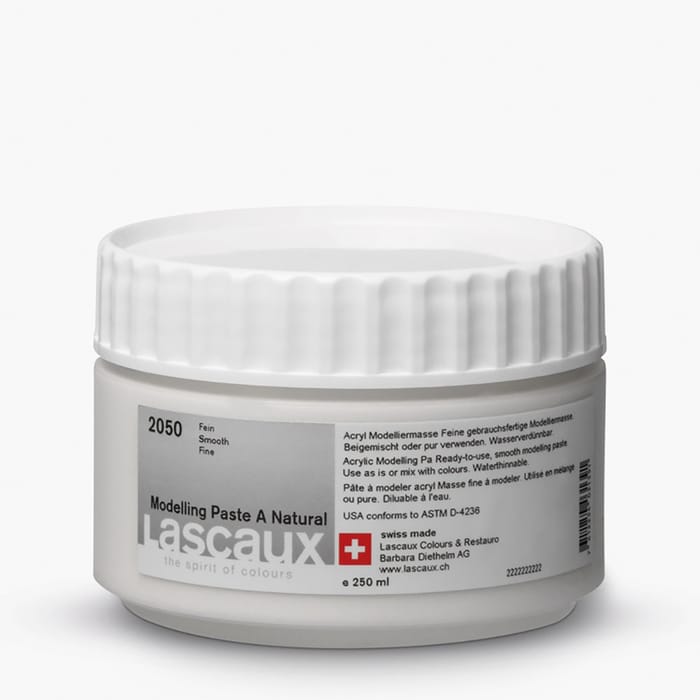
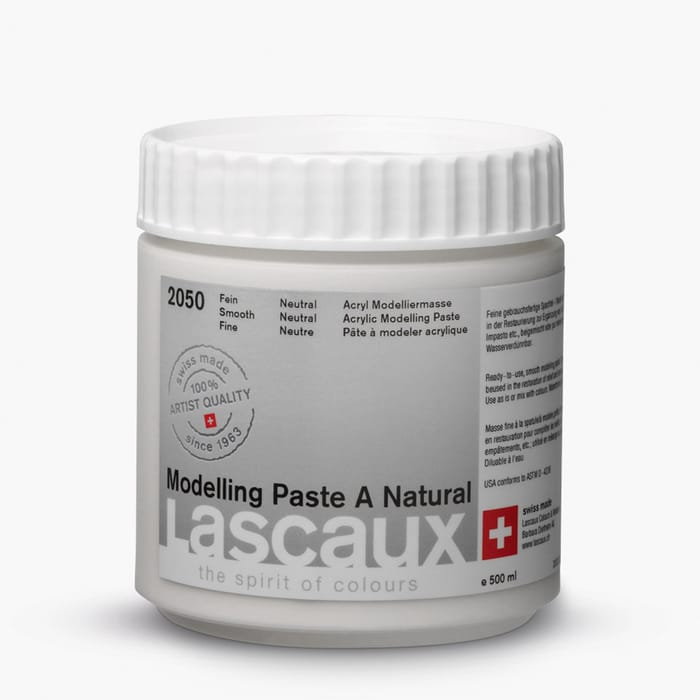
Lascaux Modelling Paste A – Modeling Paste for Painting and Restoration
Lascaux Modelling Paste A – Modeling Paste for Painting and Restoration
Share
Couldn't load pickup availability
Lascaux Modelling Paste A — the fine-grain modelling paste, the one that dries smooth
Modelling Paste A is a thickened, pure acrylic resin dispersion, filled with finely ground, high-quality calcite. It is the fine-grain paste in the family: it dries to form a smooth surface. B and C also contain quartz sand and dry rough and very rough, respectively. It comes opaque and ready to use: applied undiluted, in any final thickness.
What is it used for?
- Filling out an impasto — replacing the body of the paint layer where it is missing, to level the relief.
- Filling out a relief — restoring lost volume on a surface worked in relief.
- Fresco — completing fresco plaster, and preparing fresco-like textured grounds or substrates.
- Filling cracks with a spatula.
- Impasto and paste painting — gives body to the paint and increases its volume.
- Collage and mosaic — embedding materials in the paste.
These are the uses described by the manufacturer. For any other support or situation, see below the manufacturer's own instruction on prior suitability testing.
Why choose Modelling Paste A?
- The only one of the three that dries smooth — A smooth · B rough · C very rough. That is the criterion when the surface to be levelled is smooth.
- A certain amount of shrinkage on drying, without cracking. As it dries, a certain amount of shrinkage occurs due to water evaporation, with no crack formation, even in thick layers.
- Opaque and ready to use. Applied undiluted, in the thickness the work requires — respecting the limit of 1 cm per pass.
- Hard elastic, with strong adhesion, and water resistant once dry. Dried layers can be covered with more paste or painted over with acrylics.
- Documented manufacturing and labelling. Manufactured by Lascaux Colours & Restauro (Barbara Diethelm AG, Brüttisellen, Switzerland), which declares conformity with ASTM D-4236, the US standard for labelling chronic hazards in art materials. It is a labelling standard, not a certificate of safety: handling precautions remain those in the safety information block.
How to use — the manufacturer's figures
- Undiluted. Used as is, in any final thickness.
- Never more than 1 cm per pass, so that drying does not take longer. Already-dried layers can be covered with more paste or painted over with acrylics.
- It can be added to Lascaux acrylic colours in any proportion. Mixed with them, the Natural version lightens the tone slightly, due to its low tinting strength.
- The greatest plastic effect is obtained by applying the paste unmixed and overpainting with Lascaux acrylic colours once dry.
- pH ≈ 9.5 · density ≈ 1.5 g/cm³ (20 °C) · viscosity 150,000–300,000 mPa·s (20 °C).
Limits of use
- Never more than 1 cm per pass. It is the only thickness limit given by the manufacturer: above it, drying takes longer.
- The paste dries water resistant, and the manufacturer does not publish any removal method. Neither the technical data sheet nor the safety data sheet mention removal or a removal solvent. If used in a conservation treatment, the procedure should be documented on this assumption.
- Test suitability on the specific support before intervening. This is a written instruction from the manufacturer itself: the technical information does not exempt the user from testing the product beforehand on their support and under their specific conditions of use.
- No published drying time or shelf life, either unopened or once opened.
- Contains preservatives that may cause an allergic reaction — see the safety information block below.
Presentation and storage
- Presentation: 250 ml jar · 500 ml jar · 1 L jar · 5 L bucket.
- Colour: Natural (neutral / white). The manufacturer also makes Modelling Paste A in Mineral Grey and Black Earth, but the 500 ml jar exists only in Natural.
- Store in the original container or another of the same material, dry and cool, avoiding heat and direct sunlight.
- Shelf life: the manufacturer does not publish an expiry date, either unopened or once opened.
Manufactured by Lascaux Colours & Restauro — Barbara Diethelm AG, Brüttisellen (Switzerland).
⚠️ Safety information
EUH208 (European supplementary hazard statement on sensitisers) — Contains 1,2-BENZISOTHIAZOL-3(2H)-ONE and 2-METHYL-2H-ISOTHIAZOL-3-ONE. May produce an allergic reaction.
- Product not classified as hazardous under Regulation (EC) 1272/2008 (CLP): no pictogram or signal word.
- Eye protection: wear protective goggles if there is a risk of splashing.
- Skin contact: wash thoroughly with water and soap or a recognised skin cleanser. Do not use solvents or thinners.
- Eye contact: remove contact lenses, keep eyelids open and rinse with plenty of water for 10-15 minutes. See a doctor.
- Ingestion: see a doctor immediately. Keep at rest. Do not induce vomiting.
- Do not eat, drink or smoke while working.
- In case of spillage: keep away from ignition sources and ventilate the area well.
- Storage: in the original container or one of the same material, dry and cool, away from heat and direct sunlight.
- Waste: LER (European Waste Catalogue) code 08 01 12 — paint and varnish waste other than those mentioned in 08 01 11.
- Safety data sheet available on request.
Frequently asked questions
What is the difference from Modelling Paste B and C?
Does it need diluting? How thick can I apply it in one go?
Does it crack when it dries?
Can I tint it before applying it, or paint over it once dry?
What is used to remove it once dry?
Can I use it on any support?
Does it work as a fresco-type ground? When should I choose something else from the catalogue?
How long does it take to dry? Does the jar expire?
Have questions? Write to us on WhatsApp, visit innovart.art or email us at info@innovart.art and we'll advise you.