Skip to product information

1
/
of
1
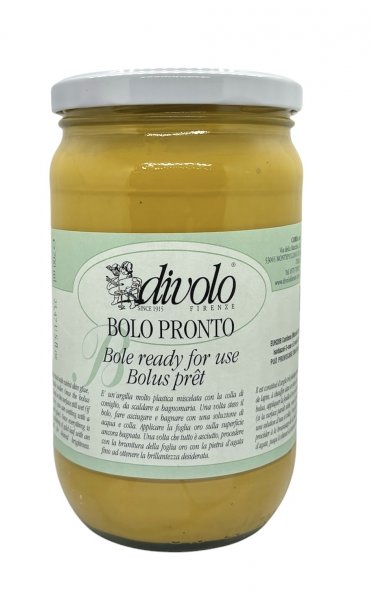
Bolex Dorado Divolo 300ml - Built-in Rabbit Skin Glue - Italian Yellow Ochre
Bolex Dorado Divolo 300ml - Built-in Rabbit Skin Glue - Italian Yellow Ochre
Regular price
€19,99 EUR
Regular price
€21,20 EUR
Sale price
€19,99 EUR
Unit price
/
per
Taxes included.
Shipping calculated at checkout.
Share
Couldn't load pickup availability
Bólex Divolo, yellow, 300 ml — the prepared Armenian bole, with rabbit-skin glue already incorporated
Prepared Armenian bole: extremely fine Armenian bole with rabbit-skin glue already incorporated by the manufacturer. It is the ground layer for water gilding —the bole, or poliment— applied over the gesso-and-glue ground and which allows the leaf to be burnished to a mirror shine. It is not an adhesive or a consolidant. It is a product of COBEA S.r.l. (Montepulciano Scalo, Siena), manufacturer of the Italian brand Divolo Firenze, a fine-art colour house since 1915.
What is it used for?
- Water gilding (doratura a guazzo) over a perfectly sanded gesso-and-glue ground: the bole is the layer that receives the leaf and that is burnished. That ground is the preparation on which the bole is applied in this technique.
- Icon painting, sacred art, frames and quality furniture: these are the works the manufacturer expressly names for this technique. (For silver leaf, the ground is the black bole: see the frequently asked questions.)
- Imitation gold leaf: the manufacturer also indicates the product for this application.
Why choose Bólex Divolo?
- The glue ratio is set by the manufacturer, not the workshop: the jar comes with the rabbit-skin glue already incorporated, so there is no need to prepare or dose glue separately.
- The manufacturer publishes the full procedure: the minimum number of coats, drying times, burnishing of the bole and the colletta at 1:10.
- Declared composition: extremely fine Armenian bole and rabbit-skin glue.
- Material documented in the C&R (Conservation-Restoration) literature: Armenian bole as a poliment for gilding is recorded in treatises from the late 14th and early 15th centuries —Alcherius, Cennini— and continues to be studied today (Hradil, Hradilová, Bezdička and Serendan, Applied Clay Science 135, 2017, 271–281).
- Manufacturer with a name and address: COBEA S.r.l. (Montepulciano Scalo, Siena), manufacturer of the Italian brand Divolo Firenze, a fine-art colour house since 1915.
How to use
- Heat in a bain-marie in a saucepan, stirring with a wooden spatula until it reaches a fluid consistency. Never over a direct flame: it damages the glue.
- Apply warm and immediately to the surface that will receive the leaf: the perfectly sanded gesso-and-glue ground.
- At least three coats, allowing drying time between coats: around half an hour at about 20 °C; if the workshop is humid, the manufacturer recommends waiting an hour.
- Once fully dry, sand any imperfections with very fine-grit paper and burnish the bole with an agate stone. This burnishing takes place before the leaf; the burnishing of the gold comes afterwards.
- Lightly dampen with water to lay the leaf: the dry bole, dampened with a little water, already has adhesive power. If sanding and burnishing have reduced adhesion, dampen with colletta: rabbit-skin glue dissolved in water at 1:10, a single light coat —if the bole softens too much it can dissolve or become waterlogged— wetting only one part of the surface at a time, laying the leaf immediately before moving on to the next area.
- Cleaning tools: hot water and neutral soap.
Presentation and storage
- Presentation: 300 ml jar, yellow colour. The manufacturer also produces the 700 ml format and the red and black colours.
- Storage: keep the original container tightly closed when not in use, in a cool, well-ventilated place, away from heat sources and open flames.
The limits, stated plainly
- Never over a direct flame: direct heat damages the glue. The manufacturer states it should be heated in a bain-marie, in a saucepan, stirring with a wooden spatula until it reaches a fluid consistency.
- It is a preparation for the gesso-and-glue ground, perfectly sanded. Not for use on metal, stone, paper, textile or outdoors.
- At least three coats, with drying time between coats. Rushing the process compromises the subsequent burnishing. The drying time between coats given by the manufacturer is around half an hour at about 20 °C; if the workshop is humid, it recommends waiting an hour.
- The colour of the bole is not interchangeable: yellow gives paler gold tones and red, warmer ones. The choice is made according to the tone the piece requires.
- An excessive layer thickness can cause the gold and the bole to detach during burnishing —this is a behaviour of the material, not specific to this brand—. It is advisable to avoid an excessive build-up of thickness.
- Water gilding is permanently sensitive to water, even once finished: water or a liquid cleaner can carry away the leaf and attack the bole and ground layers. Its maintenance is limited to dry dusting.
- Sensitive to changes in temperature and relative humidity (RH): preparations made with animal glue move with environmental cycles, and this movement opens joints and craquelures the finish. That is why the gilded piece requires an environment free of abrupt temperature and humidity swings.
- It is a ground layer, not an adhesive or a consolidant, and is not used as a retouching pigment. Its function is to receive and be burnished for the leaf.
- It is a water-based product with animal protein. Take the amount needed from the jar, keep the container closed when not in use and store it in a cool, well-ventilated place away from heat sources.
What it pairs with in our catalogue, and what alternative exists
- Underneath the bole: the Divolo Ammannitura of Bologna gesso and rabbit-skin glue, the ground on which this preparation is applied.
- For the 1:10 colletta: Divolo rabbit-skin glue, if sanding has reduced the bole's adhesion.
- On top of the bole: 14 × 14 cm imitation gold leaf, an application the manufacturer expressly indicates for this bole.
- If you'd rather prepare the glue yourself: the 1 kg red Armenian bole is supplied without glue, in red and as a 1 kg dry material. The choice hinges on the tone the piece requires and who sets the glue ratio: if the work demands matching an original red bole or adjusting the glue concentration to that specific piece, the glue-free material is the one that allows it; if what is sought is the preparation exactly as the manufacturer sets it, the prepared bole already brings it.
Frequently asked questions
Do I need to prepare rabbit-skin glue separately?
No. The manufacturer states that this bole already has the rabbit-skin glue incorporated: take the desired amount from the jar and heat it. Separate glue only comes into play for the 1:10 colletta, and only if sanding has reduced the bole's adhesion before laying the leaf.
How is it heated?
In a bain-marie, in a saucepan, stirring with a wooden spatula until fluid. The manufacturer stresses that the bain-marie is essential so the glue is not damaged by the heat of a direct flame. It is applied warm and immediately.
How many coats are needed and how long does each take to dry?
At least three, allowing drying time between coats. The manufacturer gives around half an hour at about 20 °C; if the workshop is humid, it recommends waiting an hour.
What surface is it applied to?
Onto a perfectly sanded gesso-and-glue preparation —the ground—, which is the layer on which the bole is applied in this technique. In our catalogue that layer is the Divolo Ammannitura of Bologna gesso and rabbit-skin glue.
Does the bole need burnishing before laying the leaf?
Yes. Once fully dry, imperfections are sanded with very fine-grit paper and the bole is burnished with an agate stone. It is then dampened and the leaf is laid. These are two separate burnishing steps: the bole's, beforehand; the gold's, afterwards.
Does the yellow bole work for silver leaf?
The manufacturer indicates the bole for water gilding with both gold and silver leaf. For silver leaf, the ground is the black bole; yellow gives paler gold tones and red, warmer ones. If your work is in silver, write to us and we'll look at it with the piece in front of us.
What is the difference from the Armenian bole sold without glue?
They are two different things. The tone is decided by the colour of the bole: red leans towards warmer gold tones and yellow towards paler ones. The glue concentration is decided by whoever prepares the mix: in the prepared bole it is set by the manufacturer, and in the glue-free bole it is set by the restorer for that specific piece. If the work requires matching an original red bole, the glue-free material is the one that allows it.
Have any questions? Write to us on WhatsApp, visit innovart.art or email us at info@innovart.art and we'll advise you.