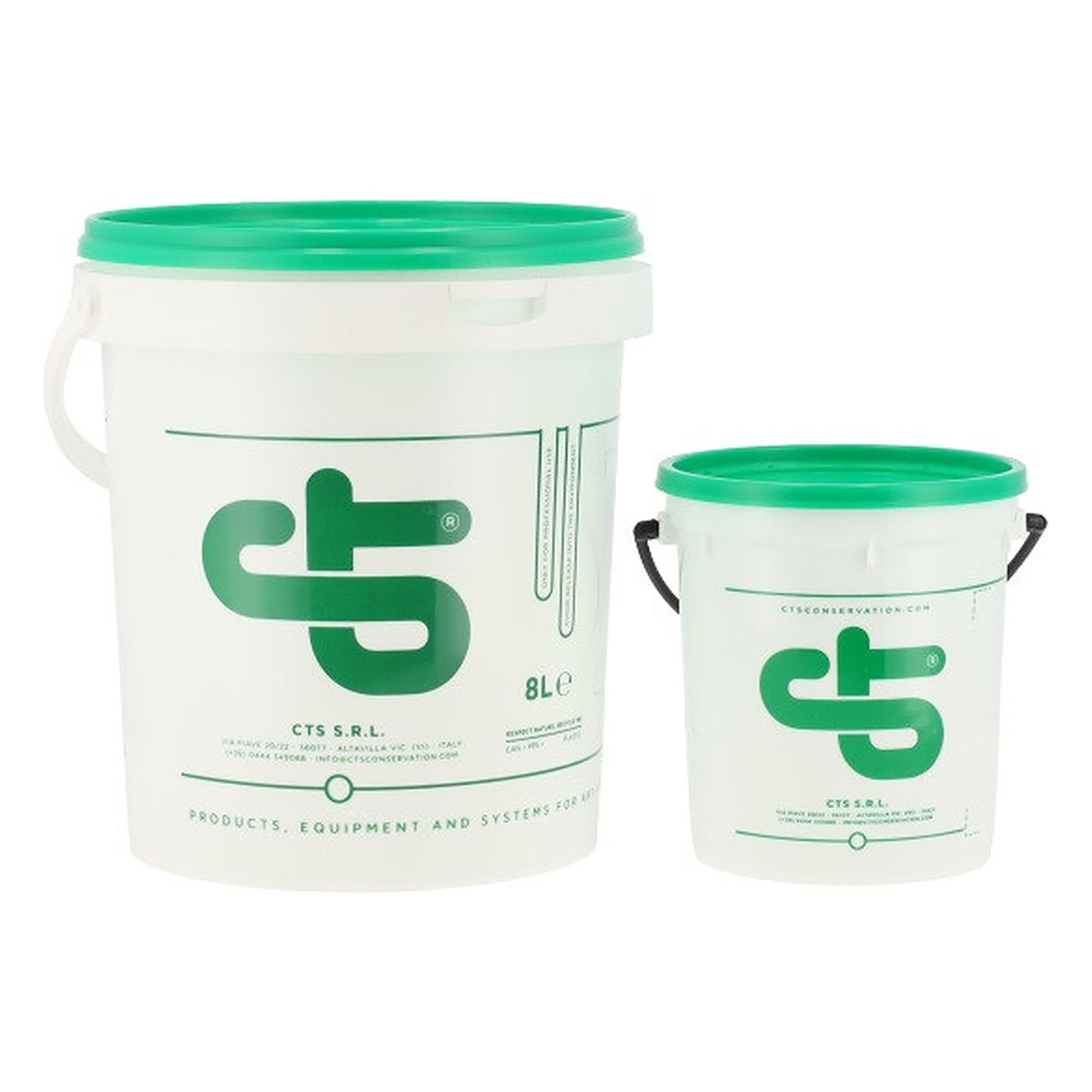
Acril 33 — acrylic dispersion (C.T.S.)
Acril 33 — acrylic dispersion (C.T.S.)
Share
Available to order
We order it in especially for you. Message us and we will confirm price, size and delivery time, with no obligation.
Couldn't load pickup availability
Acril 33 — acrylic dispersion for mortar additives and paint layer fixing
Acril 33 is an aqueous dispersion of pure acrylic resin: an ethyl acrylate/methyl methacrylate copolymer (EA/MMA) in water, with a solids content of 45-47%. C.T.S. offers it as an alternative to Primal AC-33, based on its similar chemical formulation. The manufacturer specifies it for stone, archaeological, paper and painting conservation, both indoors and outdoors.
Among our acrylic dispersions, Acril 33 is the one its manufacturer intends for use as an additive in injection grouts and in lime, cement or gypsum fillers, and for consolidating and fixing paint layers. For preparing paints, grounds and modelling pastes there is Lascaux Acrylic Emulsion D 498-M, and for linings and marouflage, Lascaux 498 HV adhesive.
What is it used for?
- Additive for mortars used for injection grouting, filling and loss compensation, with non-hydraulic or hydraulic lime, cement or gypsum, to improve their adhesion and workability.
- Binder for glazes and limewashes.
- Binder for pigments, both natural and synthetic.
- Consolidant and fixative for paint layers.
- Adhesive for paper documents.
Why choose Acril 33?
- Flexible film, backed by test data: elongation at break of 560% and tensile strength of 35 N/mm², measured to ISO 527 – UNI 8422, the international and Italian tensile test standards (C.T.S. technical data sheet).
- APEO-free formulation (alkylphenol ethoxylates, a type of surfactant), according to the 2024 C.T.S. technical data sheet.
- Alkali resistance, which is what allows it to be used in lime, cement or gypsum mortars to improve their adhesion and workability (C.T.S.).
- Compatibility with pigments and fillers, resistance to soluble salts and pH stability, according to the manufacturer.
- Film with good transparency and high binding power, according to the manufacturer.
Packaging and storage
- Available in: 1 kg and 5 kg
- Keep in the original container, tightly closed, in a dry place. Once opened, close it tightly and store it upright.
- Store and transport between 5 and 25 °C, protected from frost.
- Shelf life: practically unlimited in the original container, tightly closed, between 5 and 25 °C (C.T.S.).
- For professional use only.
Acril 33 is a C.T.S. product, supplied in its original container.
How to use it
- Dilute with water: in its liquid state it is fully miscible with water.
- Adjust the concentration to each task (consolidating, fixing, adding to a mortar or binding pigments); the manufacturer recommends preliminary tests to check consumption and effectiveness.
- Forms a film from 6 °C; its glass transition temperature (Tg) is 6-8 °C.
Technical data
- Appearance: milky white liquid with an ammoniacal odour.
- Solids content: 45-47% · viscosity: 2500-5000 mPa·s at 20 °C · pH: 9-10 · average particle size: 0.15 µm.
- Data from the C.T.S. technical data sheet (2024).
Safety
- Mixture not classified as hazardous under Regulation (EC) No 1272/2008 (CLP, the European regulation on the classification, labelling and packaging of chemicals). No pictogram and no signal word. It carries the following EUH statements (CLP supplemental hazard information):
- EUH208: Contains 1,2-benzisothiazol-3(2H)-one; 1,2-benzisothiazolin-3-one. May produce an allergic reaction.
- EUH208: Contains reaction mass of 5-chloro-2-methyl-2H-isothiazol-3-one and 2-methyl-2H-isothiazol-3-one (3:1). May produce an allergic reaction.
- EUH210: Safety data sheet available on request.
- Always follow the information on the product label.
Frequently asked questions
Is it the same as Primal AC-33?
What dosage should I use?
Can it be used with lime or cement?
How should it be stored?
In which conservation fields is it used?
Is it a hazardous product?
Any questions? Message us on WhatsApp, visit innovart.art or email us at info@innovart.art and we will advise you.