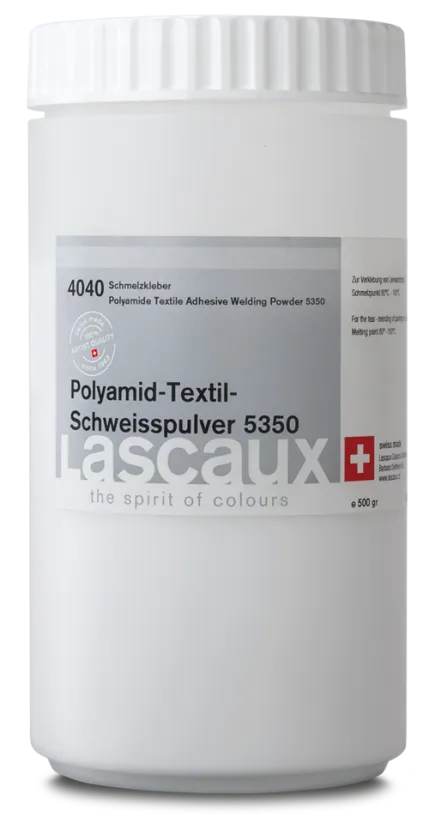
Polyamide Thermoadhesive Powder for Textiles | Lascaux 5350 (Ref. 4040)
Polyamide Thermoadhesive Powder for Textiles | Lascaux 5350 (Ref. 4040)
Share
Couldn't load pickup availability
The Lascaux Polyamide 5350 Heat-Seal Powder (Polyamide Textile Welding Powder, reference 4040) is a fine, hot-melt thermoplastic copolyamide powder adhesive, manufactured by Lascaux Colours & Restauro (Switzerland) specifically for the preservation and restoration of cultural heritage. The white, odorless powder melts at 100–110 °C and penetrates between the fibers of the fabric; upon solidification, it creates a resistant, stable, and long-lasting physical-mechanical bond. It does not require solvents at any stage: activation and reversal occur exclusively by heat.
Uses and Applications
- Lining of canvases onto a secondary fabric (restoration linen, polyester, Reemay, Stabiltex)
- Structural consolidation of deteriorated historical textiles
- Reinforcement and sealing of tears in old fabric works
- Adhesion of consolidation patches on historical tapestries and carpets
- Edge sealing in textile grafts
- Support for structurally compromised embroideries and laces
Why choose Polyamide 5350?
- Greater structural anchoring strength and long-term stability
- Resistant physical-mechanical bond upon solidification
- No solvents required — activation and reversal exclusively by heat
- Thermally reversible
Technical Specifications
- Manufacturer: Lascaux Colours & Restauro, Barbara Diethelm AG
- References: 5350 (grade) / 4040 (Lascaux ref.)
- Composition: thermoplastic copolyamide
- Physical state: fine powder
- Color: white
- Odor: odorless
- Melting point: 100–110 °C
- Density: approx. 1.1 g/cm³ (at 20 °C)
- Water solubility: insoluble
- Reversibility: thermal — by heat reactivation
- Ignition temperature: >350 °C
- Transport classification: not dangerous goods (ADR/IMDG/IATA)
- Compliance: REACH (EC 1907/2006) · ASTM D-4236
Step-by-step instructions for use
- Prepare the fabric: it must be clean, stabilized, and free of surface dust.
- Sprinkle the powder evenly over the secondary fabric or the area to be consolidated.
- Cover with silicone release paper or Teflon on both sides. Place a wool felt between the iron and the Teflon to distribute the heat evenly.
- Apply heat with a heating table, conservation iron, or heated spatula at 100–110 °C until the powder melts and penetrates between the fibers.
- Press gently during cooling — with weights or a cold press — until the adhesive completely solidifies.
- Remove the silicone release paper when cold.
- Always perform a preliminary test on a witness sample before applying to original artwork.
To reverse the adhesion: reactivate by heat at the same temperature + controlled humidification if necessary. Do not use solvents.
Substrate Compatibility
- Optimal: restoration linen, cotton, polyester fabrics (Reemay, Stabiltex, Fibrante), hemp
- With extreme caution: historical wool and silk — the activation temperature (100–110 °C) can damage very deteriorated or weakly twisted protein fibers. Mandatory preliminary testing and precise temperature control are essential.
- Not recommended without testing: fabrics with interwoven metallic fibers, fabrics with unstable pictorial layers on the surface, fabrics with dyes highly sensitive to heat.
When to choose Polyamide 5350 over BEVA 371?
Polyamide 5350 offers greater structural anchoring strength and activates at 100–110 °C. Choose BEVA 371 when you need a lower activation temperature (60–70 °C), greater flexibility, or chemical reversibility with aliphatic solvents.
Storage
Store in the original container, in a dry and cool place. Avoid direct heat and exposure to direct sunlight. No special temperature or relative humidity conditions are required according to the official SDS.
Safety and PPE
The product contains epsilon-caprolactam (1–5%) which can irritate skin, eyes, and respiratory tracts.
- Eye protection: safety glasses when handling the powder
- Skin protection: protective gloves (nitrile recommended); if in contact with skin, wash with soap and water — do not use solvents
- Respiratory protection: adequate ventilation of the work area when activating with heat
- Do not eat, drink, or smoke during handling
Safety data sheet available upon request. Complies with REACH (EC 1907/2006).
Do you have any questions? Contact us via WhatsApp, visit innovart.art, or email us at info@innovart.art, and we will advise you.